What a Beef Cut Is
A beef cut is a portion of a carcass, identified by the part of the animal it comes from and how it is separated. The names can refer to a large region, a smaller section, or a piece trimmed for a particular use. Beef Cooking Guide is an independent English information guide, not a shop, service provider, school, or organisation. A cut name helps you interpret a butcher’s label and see why the same cut may be presented differently in different markets.
Cut names and location
A beef cut is a portion of a carcass separated during butchering for sale or preparation. Its name may identify a broad area, a specific muscle, or a piece created by trimming and dividing a larger section. The animal’s anatomy provides the starting point, while cutting lines, whether bone is left in, and regional trade conventions shape the boundaries and the name used at the counter.
Chuck, for example, comes from the shoulder area. A butcher may sell it as a broad roast, divide it into smaller pieces, or trim it for ground beef; labels and exact boundaries can vary. The loin lies along the back between the rib and round regions. It is commonly divided into recognizable steaks and roasts, with names such as strip steak and tenderloin referring to particular portions. Round comes from the hind leg and is often sold as a larger roast or separated into smaller cuts.
These names are practical descriptions, not a universal numbering system: a beef primal cuts chart can show the main regions, but retail labels may distinguish cuts more finely. For example, a boneless cut and its bone-in counterpart can carry different names even when they come from nearby parts of the same region. Butchering conventions also affect which muscle groups stay together in a roast and which are divided into individual portions. When you compare beef cut names, check whether the label describes the region, the specific muscle, or the finished piece. That distinction makes typical uses easier to interpret without assuming every package with a familiar regional name is identical.
Why location matters
A muscle’s position offers clues to how much it worked during the animal’s life. Muscles used repeatedly for movement tend to have more connective tissue and can feel firmer; muscles that do less work are often finer-textured. This broad pattern helps explain why cuts from the shoulder or leg may differ from cuts along the back, even before trimming and cooking are considered.
Location is a guide, not a guarantee. A single region contains several muscles, and those muscles can differ in size, grain, connective tissue, and fat. The butcher’s boundaries matter too: one cut may combine muscles that another shop separates. Age, breed, and individual variation also affect texture. Use the named location to form an initial expectation, then consider the specific cut and how it was prepared; two pieces from the same area are not automatically interchangeable.
Muscle, Connective Tissue, and Fat
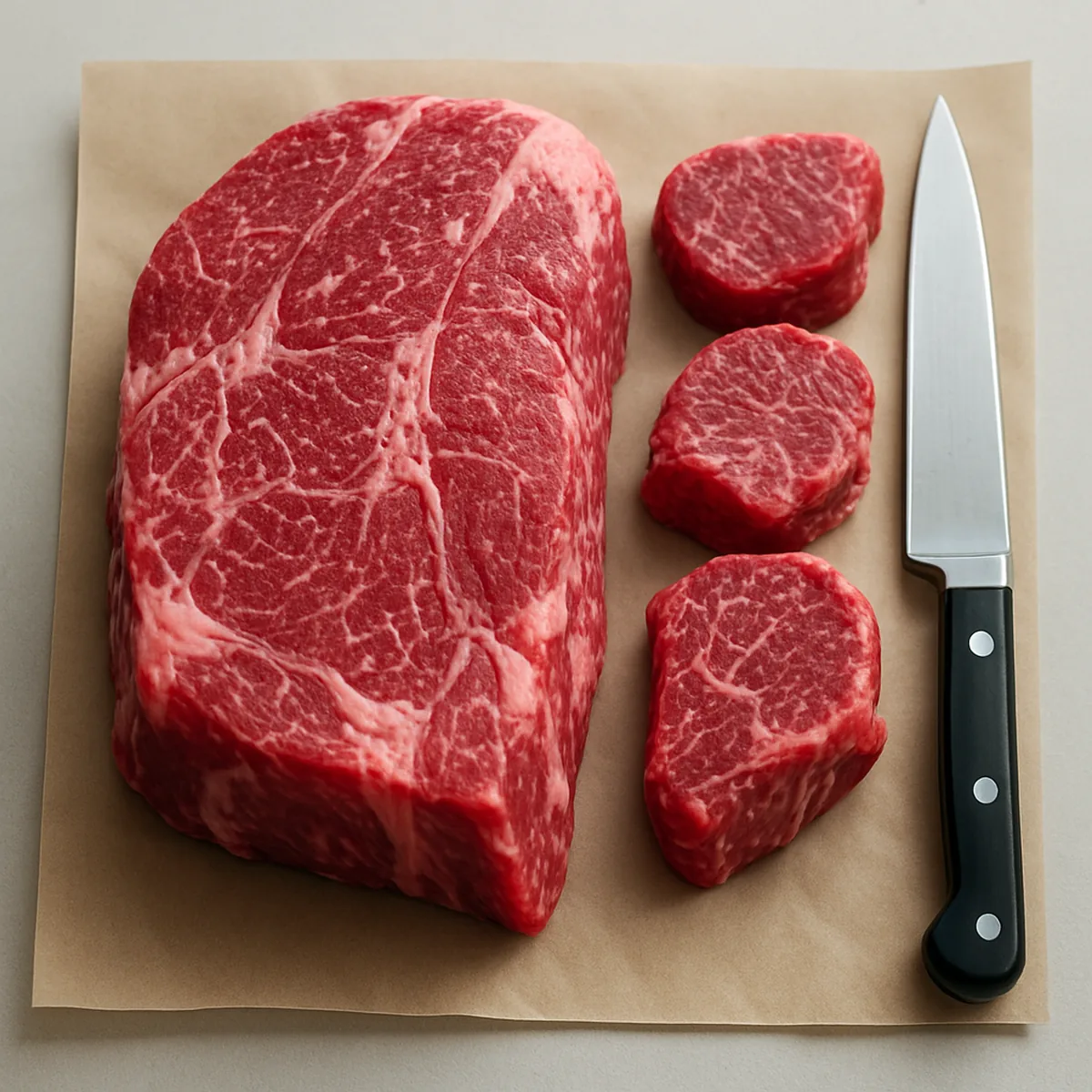
A cut’s structure helps explain why two pieces of beef can respond differently to the same heat. Muscle activity, the amount and arrangement of connective tissue, and fat distribution each shape tenderness and perceived juiciness. These traits are useful clues when comparing beef cuts and their uses, but no single feature determines the result on its own. Cooking time and temperature can soften some structures while making others feel drier or firmer. The table compares the main structural factors before turning to how different applications of heat affect them.
How structure affects texture
Muscle fibers, connective tissue, and fat affect texture in different ways. The patterns below are typical rather than absolute; trimming, animal age, and cooking also influence the result.
| Feature | Typical texture effect | Cut examples and likely approach |
|---|---|---|
| Muscle use and fiber structure | Frequently used muscles tend to have firmer, more pronounced fibers. Fiber direction can make a slice seem chewy if it is cut parallel to the grain. | Round muscles are often lean and firm; slicing thinly across the grain shortens the fibers. Tenderloin, a less-worked muscle, is notably fine-textured and suits brief cooking. |
| Connective tissue, including collagen | More connective tissue can make meat resistant when cooked briefly. With sufficient time in moist heat, collagen gradually softens and contributes a yielding, gelatin-rich texture. | Shoulder and shank contain substantial connective tissue. They are commonly braised or simmered until a fork can separate the fibers, rather than treated like quick-cooking steaks. |
| Intramuscular fat, or marbling | Fat between muscle fibers melts during cooking and can make meat seem richer and juicier. It does not prevent the muscle itself from losing water if overheated. | Ribeye usually has more visible marbling than a lean sirloin steak. A hot grill or pan can render some of that fat while browning the surface. |
| External fat and fat seams | A fat cap can protect the surface from drying as the cut roasts, while seams between muscles affect how easily a cooked piece separates. | A fat-capped roast benefits from retaining some surface fat during roasting; seams in a chuck roast become less distinct after prolonged braising. |
These features overlap: a well-marbled cut can still have firm fibers, and a lean cut can be tender if its muscle structure is fine. For quick cooking, favor fine texture and modest connective tissue; for prolonged cooking, connective tissue can become an advantage.
What cooking method changes
Quick cooking exposes meat to high heat for a short time, as in pan-searing or grilling. Surface browning develops rapidly, while the center has limited time to heat through. As muscle proteins warm and set, the fibers contract and release some of their water; continued heating makes this moisture loss more noticeable. This is why a naturally tender piece can become firm and dry if it stays over the heat too long. Moist, prolonged cooking applies gentler heat over a longer period, often with liquid in a covered pot. In a braise or simmer, collagen in connective tissue gradually breaks down into gelatin, softening tough, structured meat. A liquid kept at a gentle simmer, roughly 85–95°C, provides steady heat without the agitation of a hard boil. Time matters: collagen softening is gradual, and simply reaching a particular temperature does not make a firm cut tender instantly. The practical distinction is to cook low-connective-tissue cuts quickly and stop once they reach the desired doneness; give collagen-rich cuts sustained moist heat until their fibers yield easily.
Common Beef Cut Groups
Familiar beef cuts are often grouped by their shape and the way they are sold, such as steaks, roasts, ribs, and smaller specialty cuts. A beef primal cuts chart can show broad sections of the carcass, but retail names and trimming choices differ among regions and butchers. Within one named cut, thickness, bone, and how it is portioned can change its texture and typical use. The examples below describe common patterns rather than a guarantee that every piece with the same name will cook identically.
Roasts and steaks
Roasts are usually sold as larger portions, while steaks are cut into individual servings; familiar names often point to a broad area and form. These examples show how thickness and structure shape common uses.
- Rib: Rib roasts and ribeye steaks come from the rib section. A thick roast is commonly served in slices, while a ribeye is portioned for individual cooking.
- Loin: Strip steaks, tenderloin steaks, and larger loin roasts come from the back. Their relatively fine-grained muscles are commonly sold as tender steak or roast portions.
- Round: Round cuts come from the hind leg and include top round and eye of round. Their lean, compact form is commonly sold as roasts or thin-sliced beef.
- Brisket: Brisket is a broad chest cut commonly sold whole or divided into sections. Its large format makes it familiar as a roast-sized piece for long, low cooking.
- Steak and roast formats: A bone-in roast and a boneless roast of similar weight have different shapes; thickness and surface area affect how evenly heat reaches the center.
Retail labels may combine a muscle name with a portion style, such as a strip steak or a whole roast, and those terms are not always used uniformly. For steaks, thickness can range from about 1 inch to 2 inches; a thicker portion takes longer for heat to reach its center than a thinner one.
Shanks, ribs, and other cuts
Some cuts are recognized by their position, bone, or shape rather than by whether they arrive as a steak or roast. Shank, short ribs, and brisket are common examples with distinct retail forms.
- Shank: Shank comes from the lower leg and is often cross-cut into thick, round portions with a central bone. It is commonly used in braises, soups, and stews.
- Short ribs: Short ribs are cut from the rib or plate area, and some styles include a substantial section of bone. They are commonly sold in individual pieces or longer strips.
- Brisket portions: Butchers may divide brisket into a flatter section and a thicker, more marbled section, or sell it whole. Labels and trimming can vary between shops.
- Chuck: Chuck comes from the shoulder and may be sold as roasts, boneless stew pieces, or individual steaks. Its shape and visible seams vary with the specific muscle.
- Flank and skirt: Flank comes from the abdominal area, while skirt is associated with the diaphragm. Both are usually thin, broad cuts, but they are separate muscles with different grain patterns.
Bone-in and boneless versions can carry different names, and a butcher may use a local label for a familiar cut. For example, short-rib style and portion size vary, so a name alone does not promise identical thickness, bone content, or results.
Beef Shank and Other Slow-Cooking Cuts
Slow-cooking cuts are often chosen for the way their connective tissue changes during long, moist cooking. Beef shank is a useful example, but chuck, brisket, and short ribs each have different proportions of muscle, fat, bone, and connective tissue. Those differences affect how a cut behaves in a braise, stew, or soup. Comparing the cuts helps explain why a cooking method that suits one may need adjustment for another. Related recipes and comparisons can make those differences easier to assess.
What makes a cut suitable
Connective tissue includes collagen, which helps hold muscle fibers together. Cuts with a substantial amount of it can feel firm when cooked quickly, because the collagen has had little time to soften. During extended cooking with moisture, collagen gradually breaks down into gelatin, giving the surrounding liquid more body and making the meat easier to pull apart. That change is why many such cuts suit braising, stewing, and simmering rather than brief, high-heat cooking.
Beef shank illustrates the pattern: it is a firm cut with plenty of connective tissue, and it is often sold in cross-cut portions with a bone in the center. A covered braise or a steady simmer keeps the meat surrounded by moisture while it cooks. At a gentle simmer, roughly 190–205°F (88–96°C), shank commonly needs several hours; a range of about two to three hours is a starting point, not a fixed finish time. The meat’s tenderness is a more useful indicator than the clock.
Other cuts used for long cooking do not behave exactly like shank. Chuck, brisket, and short ribs differ in shape, fat content, bone, and the amount and arrangement of connective tissue. A fatty piece of short rib may enrich a braising liquid differently from a leaner portion of shank, while a broad brisket may need different handling simply because of its size. Even pieces from the same named cut can vary, so the result depends on the particular piece as well as the cooking conditions.
Moist, extended cooking is a strong match for collagen-rich meat, not a guarantee that every cut will finish with the same texture or in the same time. Too little cooking can leave connective tissue firm; cooking far beyond tenderness can make muscle fibers dry or crumbly even in liquid. Beef shank is therefore a clear example of suitability, while the characteristics of each other cut still matter.
How to use the comparison pages
When comparing shank with chuck, brisket, or short ribs, look at more than the cut name. Note the cut’s location, the amount of connective tissue and visible fat, whether it includes bone, and the size and thickness of the portion. These details help explain why two cuts intended for slow cooking may need different amounts of liquid, space in the pot, or time to become tender.
Related recipe topics can show how shank is used in a braise, stew, or soup, while comparison topics can set it beside other cuts for the same method. Those examples show the choices behind a dish, rather than suggesting every slow-cooked cut follows one schedule. A cross-cut shank portion and a large boneless piece of chuck, for instance, differ in shape and bone, so recipe timing may not transfer directly.
Choosing a Cut for a Dish
A good recipe match depends on the texture you want, the cooking method, and the size of the piece you are buying. A steak cooked quickly needs a different shape and tenderness from a roast or a pot of beef simmered for hours. Recipe timing also assumes a particular cut size, so a thick steak or large roast may not cook like the smaller pieces described. Use the cut name as a starting point, then check the cut’s form and preparation before choosing.
Match texture to method
Start with the result you want: a tender, browned steak, slices from a roast, or soft pieces in a moist dish. Then compare the recipe’s method and stated size with the cut you have. The ranges below are practical starting points; follow the recipe’s timing for its specific shape and weight.
| Desired result | Method and useful cut examples | Size to compare with the recipe |
|---|---|---|
| Juicy steak with a browned surface | Grill or pan-sear tender cuts such as ribeye, strip steak, or tenderloin. | About 1–1.5 inches thick; thickness matters more than total weight for quick cooking. |
| Evenly cooked roast for slicing | Roast a compact sirloin roast or top round; choose a piece with a fairly uniform shape. | Compare the recipe’s stated weight; a 2–4 lb roast is a common home-cooking size. |
| Soft pieces in a moist dish | Braise chuck or shank in a covered pot with liquid at a gentle simmer. | For stew, cut pieces to roughly 1.5–2 inches; for a whole braise, match the recipe’s weight and thickness. |
For quick cooking, choose steaks of similar thickness so they finish at roughly the same time; a very thin piece can overcook while a thicker one is still warming through. For roasting, match both weight and shape, since a long, narrow piece will cook differently from a compact roast of equal weight. For moist, extended cooking, use the recipe’s specified cut form and allow enough time for a whole piece or evenly sized chunks to become tender. If the recipe names a cut you cannot find, compare its intended texture, thickness, and preparation rather than substituting by price or appearance alone. Recipe guidance for steaks, roasts, braises, and beef stews can help narrow the choice, while cut-comparison topics can clarify how neighboring options differ.
Check the cut name
Beef cut names vary by country, region, and butcher, so the same word may not identify precisely the same portion everywhere. A recipe written for one market may call for a cut sold under another name locally. Before substituting, check where the cut comes from and whether the recipe expects a steak, roast, boneless piece, or bone-in portion. Compare the cut’s shape and preparation with the recipe: note whether it is thick or thin, tapered or compact, and whether a bone remains. Also check whether it is sold whole or already sliced or cubed; those details affect cooking time even when two labels sound similar. A butcher can often identify a local equivalent from the recipe’s description and intended method. Use recipe topics for the same dish and comparison topics for similarly named cuts to verify a match. When names differ, the cut’s form, size, and intended cooking method are more reliable guides than the label alone.